11 Joseph and Ann Crawford, sons Alexander Fraser and George Walter
In 1793, when Revolutionary France declared war on Britain, the reverberations were felt even in the remote glens of Strathspey. The call to arms echoed across the Highlands, and among those who answered was Joseph Crawford, the son of George Crawford the bleacher, born around 1773.
Joseph joined the 97th (Strathspey Highlanders) Regiment of Foot, raised on 8th February 1794 by Sir James Grant of Grant, the same benevolent landlord who had brought his father to Grantown to establish the linen bleaching industry. It was a short-lived Highland regiment, and its troubled history would be emblematic of the difficulties facing Highland recruitment in an age when the old clan system was dying but the new industrial order had not yet fully taken hold.
Joseph’s achievement of the rank of sergeant by age 21 was remarkable. Unlike officers, who could purchase their commissions, NCO ranks like sergeant were earned through merit. To hold such a rank at his age meant Joseph possessed qualities that set him apart from the ordinary soldier. He was highly literate and numerate, strict requirements for NCOs who served as the administrative backbone of a company, keeping track of pay, equipment, rations, and official reports for thirty to fifty men. His education at a school in Elgin, when the family lived there in the 1780s, had prepared him well.
But there was another dimension to Joseph’s rank. The name “Crawford” was a Lowland name, not a Highland one. In a regiment raised from Strathspey, this made him something of an outsider, yet also, perhaps, more valuable. Highland regiments often chose men like Joseph, with Lowland names and modern skills, for their administrative ability and their capacity to communicate with the English-speaking high command. His rank at such a young age also suggests he had the personal recommendation of the Grant family, his father George was, after all, one of Sir James’s trusted industrial managers.
Sir James Grant faced an arduous task in raising the 97th. He had already raised a fencible regiment, a volunteer force for home defence against potential French invasion, and most of the healthy young men from Strathspey had joined it. The fencibles were popular because they would not be sent abroad; they would defend Scotland, protect their homes, fight on familiar ground. But the 97th was a regiment for general service, which meant it could be sent anywhere in the world that Britain’s farflung wars demanded.
A military historian of the period wrote:
“Though the corps was numerically completed to 1000 men within the stipulated time, all of them were not of that class which formed the Fencible corps. The Lieutenant-Colonel, Major, and others of the officers, were not natives of the North, and without local knowledge or influence; their commissions depending on their success in recruiting, their principal object was to procure a sufficient number capable of passing muster, and, as money in manufacturing towns effected what influence did in the North, many men were recruited whose character and constitutions could bear no comparison with men of regular and hardy habits raised in the agricultural districts.”
In other words, the 97th was a mixed lot. The flank companies, the grenadiers and light infantry, the elite of any regiment, were excellent, filled with hardy Highlanders. But many of the battalion companies were made up of men recruited from manufacturing towns, drawn by bounty money rather than clan loyalty or territorial connection. The records show that a large proportion of the 1,000 men enlisted weren’t even British, they were from numerous European countries, many of them Polish and Swiss mercenaries or refugees from the European wars.
Still, Sir James Grant had raised 1,300 soldiers for the service of the Crown within a remarkably short time. It was a testament to the power of “family, territorial, and personal influence”, the last gasp of the old Highland social order, harnessed now not for Jacobite rebellion but for King and Country.
The 97th was inspected and embodied at Elgin by Major-General Sir Hector Munro and ordered south to England in 1794. Joseph Crawford, now a sergeant at the age of 21, found himself stationed at Hillsea Barracks near Portsmouth, a world away from the bleachfields of Grantown.
Hillsea Barracks had been built in the 1780s on the site of Gatcombe Manor, requisitioned by the War Office for military purposes. The barracks consisted of rows of long wooden huts arranged around three sides of a parade ground, a far cry from the stone cottages and Highland landscapes the Strathspey men knew. For Joseph, it represented a dramatic change from the world he had known, but also an opportunity to prove himself in the wider theatre of Britain’s wars.
From Portsmouth, the 97th served as marines aboard Lord Howe’s Channel Fleet patrolling the English Channel in 1794. This was dangerous, uncomfortable work unlike anything Highland soldiers had experienced. Marines were the soldiers aboard warships, they manned guns during naval battles, provided security, enforced discipline, and could be sent ashore for amphibious operations.
For Joseph, this meant months at sea aboard a man-of-war, living in the cramped, swaying “between-decks” of a wooden warship. As a sergeant, he was responsible for maintaining discipline among the Strathspey men in conditions that tested even the hardiest souls. He would have been stationed on the quarterdeck or in the gangways during battle, directing platoon fire against French ships, the deafening roar of 32-pounder cannons just feet below him, the spray of deadly splinters when enemy shot struck the ship’s timbers.
Members of the 97th, including officers from Strathspey, were present at the Battle of Groix on 23rd June 1795, when Lord Howe’s fleet engaged French warships off the Brittany coast. As a sergeant, Joseph would have been on the poop deck or in the fighting tops, leading a squad of Strathspey sharpshooters to pick off French officers and sailors on enemy ships, a terrifying baptism of fire for a young man from the hills of Speyside.
It was during this time in Portsmouth that Joseph Crawford met Ann Fraser. She was from Wymering, a small village just north of Portsmouth, and she was 21 years old, the same age as Joseph. One can imagine the meeting: perhaps she was a servant in one of the better houses near the barracks, or working in a shop that served the garrison trade, or attending a dance where local girls met soldiers. The Highland sergeant in his regimentals, speaking with the distinctive accent of Strathspey, must have cut a romantic figure.
The 97th had been issued distinctive uniforms, red jackets, waistcoats, and breeches that earned them the nickname “Red Knights,” a striking look compared to the white waistcoats of other units. Joseph, as a sergeant, would have carried a sergeant’s sword and spontoon, the long polearm that marked his rank, and possessed the bearing of a man responsible for the lives and discipline of fifty soldiers.
They married on 5th June 1795 at Wymering. The marriage record notes: “Crawford, Joseph, of the 97th Reg. of Foot, sergeant, 21 b., & Ann Frazer. of Wymering, 21, sp.”
It was a wartime marriage, made in the knowledge that Joseph could be sent anywhere at any moment, that he might never return. The marriage also represented a bridge between two worlds, the Hampshire countryside and the Scottish Highlands, the English girl and the Highland sergeant, the settled agricultural community and the mobile military life.
Back in Grantown, Joseph’s father George was struggling. In September 1795, he had written to Sir James Grant from the bleachfield, a letter that reveals both his desperation and his faith in the old bonds of patronage:
“I could not procure a man servant this summer which has rendered it difficult to carry on the farm and bleaching with so little help as I have at present. I had a letter from my son Joseph last post in which he lamented the distress I was in for want of help to carry on the different businesses I was engaged in, and wished me to write to you to see if it would be possible to grant him a furlough for a few months and he would return and assist me until the businesses of this year would be complete.”
It was a remarkable request, possible only in the personal, feudal world of Highland military recruitment. George Crawford was asking Sir James Grant, the man who had raised the 97th Regiment, to release his soldier son from military service during wartime so that he could help with the bleaching. That George felt he could even make such a request speaks to the blurred boundary between landlord and commanding officer, between tenant and soldier, that characterized clan-based regiments.
In a regular English regiment, such a petition would have been unthinkable. But the 97th was Sir James Grant’s regiment, raised under “Letter of Service” which gave him the right to appoint his own officers and NCOs. Joseph was not just a sergeant, he was the son of one of Sir James’s trusted managers in Grantown, a man whose family held influence in the planned community the laird had created. The personal connection mattered.
Whether Joseph received his furlough, or whether events overtook the request, we do not know. What we do know is that by the end of 1795, the question had become moot.
In autumn 1795, the 97th Regiment began to be broken up. On 24th December 1795, it was officially disbanded. The men and officers were drafted into different regiments, the flank companies, the best men, were turned over to the famous 42nd Foot (the Black Watch), then preparing to embark for the West Indies. Other soldiers transferred to the Royal Marines or various other regiments.
For a 20-year-old sergeant married just six months earlier, this was a moment of terrible choice. If Joseph stayed in the army and was drafted to the Black Watch, he would almost certainly be sent to the Caribbean, where disease killed more British soldiers than combat. The Black Watch companies bound for the West Indies would suffer appalling losses, yellow fever was a death sentence for thousands of Highland soldiers in the coming years.
Alternatively, he could transfer to the Royal Marines and spend the next decade or more at sea, away from his new wife and his aging father who desperately needed him. Or he could desert, a common enough occurrence when regiments were being broken up and men faced being drafted to fever-ridden tropical postings.
There is a record of a Joseph Crawford deserting around this time. Desertion may seem dishonourable, but for a man with a new wife, an aging father who needed him, and the prospect of almost certain death in the West Indies, it may have seemed not just rational but morally necessary. The chaos of wartime administration, the mass shuffling of men between units, the confusion of disbandment, all of this created opportunities for men to simply disappear.
Alternatively, he may have been discharged when the regiment disbanded, or he may have served out his term and been released. The records are unclear, and the administrative confusion of late 1795 often left such matters unresolved.
What is certain is that Joseph Crawford made a choice, whether formal discharge, desertion, or some arrangement facilitated by Sir James Grant’s influence, that took him out of the army and set him on a path back to Scotland.
By 1799, Joseph and Ann Crawford were back in the Highlands, settled at Kirktown of Inverallan, the very place where George Crawford’s bleachfield was located. They had brought the south with them in the form of Ann Fraser, a young Englishwoman from the Portsmouth countryside now transplanted to the wilds of Inverness-shire.
One can only imagine what Ann made of this new world. The winters were longer and darker than anything she had known in Hampshire, the summers plagued by midges, the language and customs strange. Gaelic would have been spoken in the cottages around her, the social rhythms governed by agricultural seasons and Presbyterian Sabbaths rather than the garrison routines and market days of Portsmouth. But she had her husband, and perhaps in Joseph’s family, his father George, his brother Walter struggling to keep the bleachfield running, his brother Samuel already established as a merchant in Elgin, she found welcome.
The parish records note the birth of their son:
“George Walter, son to Mr. Joseph Crawford residing at Kirktown of Inverallan and his spouse Anna Fraser born 11th and bapt. 17th April 1800.”
The child was named for his grandfather George and for Walter, Joseph’s younger brother. It was a traditional Highland naming pattern, tying the generations together, affirming Joseph’s place in the family and the community despite his years away at war.
Another son had been born earlier, around 1797, Alexander Fraser Crawford, a name that honoured Ann’s family and her Hampshire roots. The choice of names for their two sons reflected the dual identity the family now embodied: Highland and Lowland, Scottish and English, rooted in Strathspey but touched by the wider world of Britain’s wars and empire.
After the birth of George Walter in 1800, Joseph Crawford largely vanishes from the historical record. We have birth, death, and marriage records of his children and grandchildren, but of Joseph himself, nothing. He left no will that survives, no property records, no court cases, no letters.
This absence is itself suggestive. Joseph was not a man of property like his father George or his brother Samuel. He had been a soldier, a sergeant, a man of some status and responsibility, but he had left the army without the pension that long service would have provided. He presumably returned to working-class life: perhaps as a labourer, perhaps assisting his father and brother at the bleachfields, perhaps farming a small plot. Such men left few traces beyond their children.
The skills Joseph had learned in the army ,literacy, numeracy, the ability to keep accounts and manage men, may have helped him find work. Perhaps he became an overseer or a clerk, a position of modest authority that nonetheless left no documentary trace. Or perhaps the return to civilian life was harder than expected, the peacetime world offering fewer opportunities than the wartime army had provided.
Ann Fraser Crawford, the girl from Wymering who had married a Highland sergeant in the last year of his regiment’s existence, disappears equally from the records. One imagines she found the Highlands harsh after the relatively gentle countryside of Hampshire. But she had her children, and perhaps in the tight-knit community of Kirktown of Inverallan, she found a place. The wife of a former sergeant, a literate woman from the south, may have occupied an ambiguous position, neither quite Highland nor quite gentry, but respectable enough.
We do not know when Joseph died, or Ann, or where they are buried. Perhaps they rest in the churchyard at Cromdale or Inverallan, their graves unmarked or the stones weathered beyond reading. Perhaps they moved away in their later years and died elsewhere. The records are silent.
Joseph Crawford, sergeant, late of His Majesty’s 97th Regiment, had been part of that brief moment when the old and new orders overlapped, when a bleacher’s son from a planned industrial town could become a Highland sergeant, serve as a marine in naval battles, marry an English girl in a garrison town, and return to the glens to raise his sons in the shadow of his father’s failing business.
His story, like that of his regiment, is one of brief service, hard choices, and the long fade into obscurity, another thread in the vast tapestry of the Napoleonic Wars, another life shaped by forces far beyond his control.
Alexander Fraser Crawford: The Edinburgh Lawyer
Alexander Fraser Crawford, born around 1797, was named to honour both sides of his family, Crawford for his father’s Highland lineage, Fraser for his mother’s Hampshire roots. He would become the family’s first professional man, rising from the world of bleachfields and barracks to Edinburgh’s legal establishment.
By the 1820s, Alexander had trained as a writer, the Scottish term for a solicitor or lawyer, and established himself in Edinburgh. His father’s literacy and administrative skills as a sergeant may have made the value of education clear to the family, and Alexander pursued it to a level his father never could. On 4th April 1824, he married Elizabeth Hogarth, and the couple settled into the life of Edinburgh’s respectable middle class. By the 1840s, they were living at House 72 Broughton Street, in the heart of the New Town, that elegant Georgian expansion of Edinburgh that represented everything modern and sophisticated in Scottish urban life.
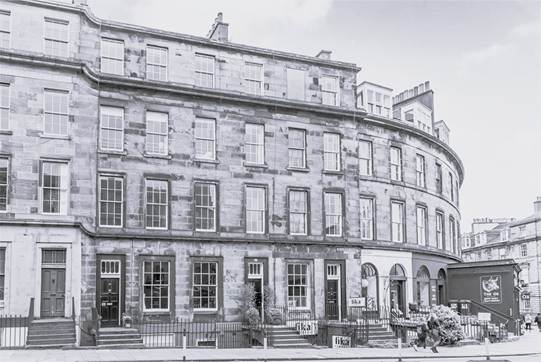
Alexander and Elizabeth had three sons and two daughters, John Dudgeon Crawford 1826, George Walter Crawford 1827, Margaret Adams Crawford 1828-1895, Joseph, Crawford 1830 and Marion 1832
In 1849, at the age of 46, Alexander Fraser Crawford found himself on the wrong side of the law he had spent his career practicing.
In 1849, he was indicted for sending threatening letters. The crime took place in Potterrow, a district of Edinburgh’s Old Town, quite different from the genteel streets of Broughton where Alexander lived. In February 1850, he stood trial in Edinburgh, described in the court records as “married” and giving his birthplace as Inverness ,a slight inaccuracy, as he had been born in Inverallan, but close enough to suggest he identified with his Highland origins even after decades in the capital.
What makes the case particularly intriguing is the identity of one of the victims: William Crawford of Bellevue Crescent, Edinburgh. Was this a relative? Another branch of the Crawford family that had made its way to Edinburgh? A business associate? A rival? The records do not say, but the fact that Alexander sent threatening letters to someone who shared his surname suggests a family quarrel, a dispute over inheritance, or some other intimate grievance that had festered into criminality.
The outcome of the trial is not recorded in the documents we have. Did Alexander serve time in prison? Was he fined? Was he struck off the rolls of writers, his professional career ended? Did Elizabeth stand by him, or did the scandal prove too much for a respectable Edinburgh matron to bear? We do not know.
Alexander’s story is a reminder that the Crawfords who stayed in Scotland did not all prosper, and that respectability could be as fragile as it was hard-won. While his cousins in Australia were building new lives on the goldfields, Alexander was entangled in the old world’s complications, the law, property, reputation, and the weight of expectations that could crush as easily as elevate.
George Walter Crawford: Lost to History
George Walter Crawford, born 11th April 1800 and baptized six days later at Kirktown of Inverallan, was named for his grandfather George and his uncle Walter, a traditional Highland naming pattern that tied him to both generations of the family. He was born in the same year that his grandfather wrote his final despairing letter to Sir James Grant, in the same year that the old bleacher’s health was failing and the linen industry of Grantown was entering its death throes.
After that baptismal record, George Walter Crawford disappears completely from history.
We do not know if he married. We do not know what occupation he pursued. We do not know if he had children, or where he lived, or when and where he died. He is a ghost, a name in a parish register and nothing more.
This silence is itself significant. It suggests that George Walter did not rise to professional status like his brother Alexander, there are no legal directories, no property records, no court cases to mark his passage through the world. It suggests he did not emigrate to Australia or America, as his cousins did, there are no shipping manifests, no colonial records. It suggests he did not remain in the immediate area of Inverallan, the local records, carefully kept by parish ministers, contain no marriage or death for a George Walter Crawford of the right age.
Perhaps he moved to one of Scotland’s industrial cities, Glasgow, Dundee, Aberdeen, and was swallowed up in the anonymity of urban working-class life. Perhaps he died young, in his twenties or thirties, before establishing himself in any trade or profession. Perhaps he emigrated to England or Ireland and his records are lost among the millions who made such moves in the early nineteenth century.
Or perhaps, like his father Joseph, he simply lived a quiet, unremarkable life that left no trace beyond his children, and if he had children, we have not yet found them.
The contrast between the two brothers is striking. Alexander, whose life is documented through legal records, property records, marriage records, and criminal proceedings, a life lived in the public sphere of Edinburgh’s professional classes. George Walter, who appears once in the baptismal register of Kirktown of Inverallan and then vanishes as completely as if he had never been born.
Both fates were possible in early nineteenth-century Scotland. One could rise, as Alexander did, into the professional middle class, and risk everything in a moment of poor judgment or despair. Or one could disappear into the mass of working people whose lives, however full and meaningful to themselves and those who knew them, left no documentary trace for historians to follow.
 Warami Eora:Hello Sydney